
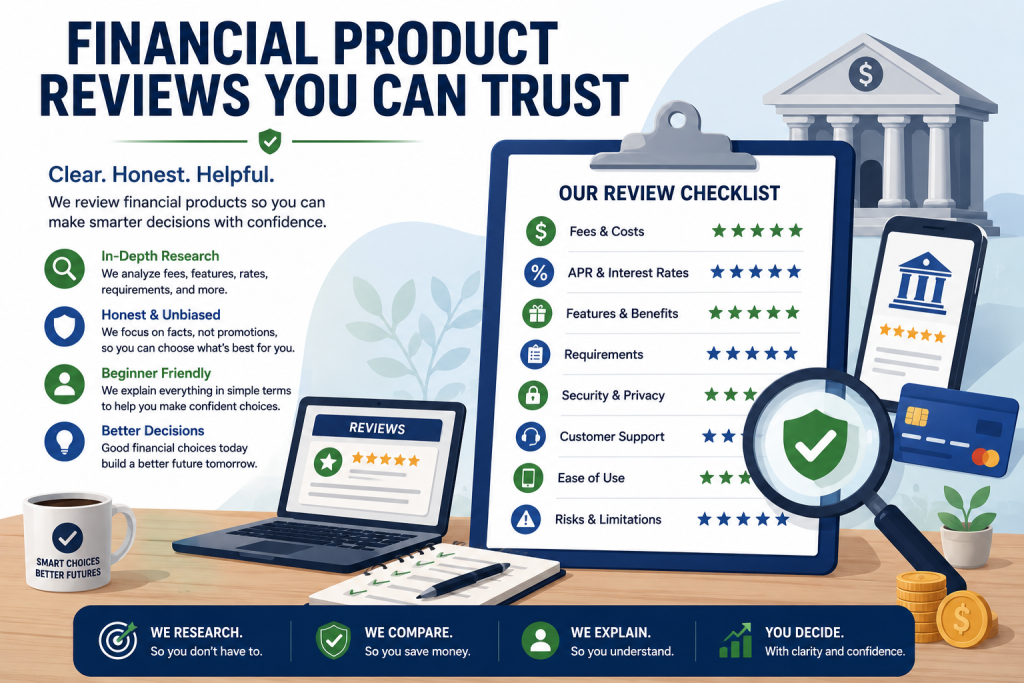
Choosing a financial product can be confusing, especially for beginners.
There are many options available, including bank accounts, credit cards, loans, finance apps, budgeting tools, savings accounts, and other personal finance services.
Each product may look helpful at first, but the details matter.
Fees, APR, account requirements, security features, customer support, ease of use, and limitations can all affect whether a financial product is a good fit.
This article explains how financial products can be reviewed and what beginners should pay attention to before applying or signing up.
Why Reviews Matter
Reviews matter because financial products can affect your money, credit, privacy, and daily financial habits.
A product may advertise rewards, fast approval, no fees, simple tools, or special benefits.
However, the real value depends on the full terms and how the product works in real life.
A review can help you understand:
- What the product is for
- Who the product may fit
- What fees may apply
- What APR or interest rates apply
- What features are included
- What requirements must be met
- What risks or limitations exist
- How easy the product is to use
- How customer support works
- Whether the product is beginner-friendly
Reviews should not replace your own research.
They should help you know what to check before making a decision.
We Look at Fees and Costs
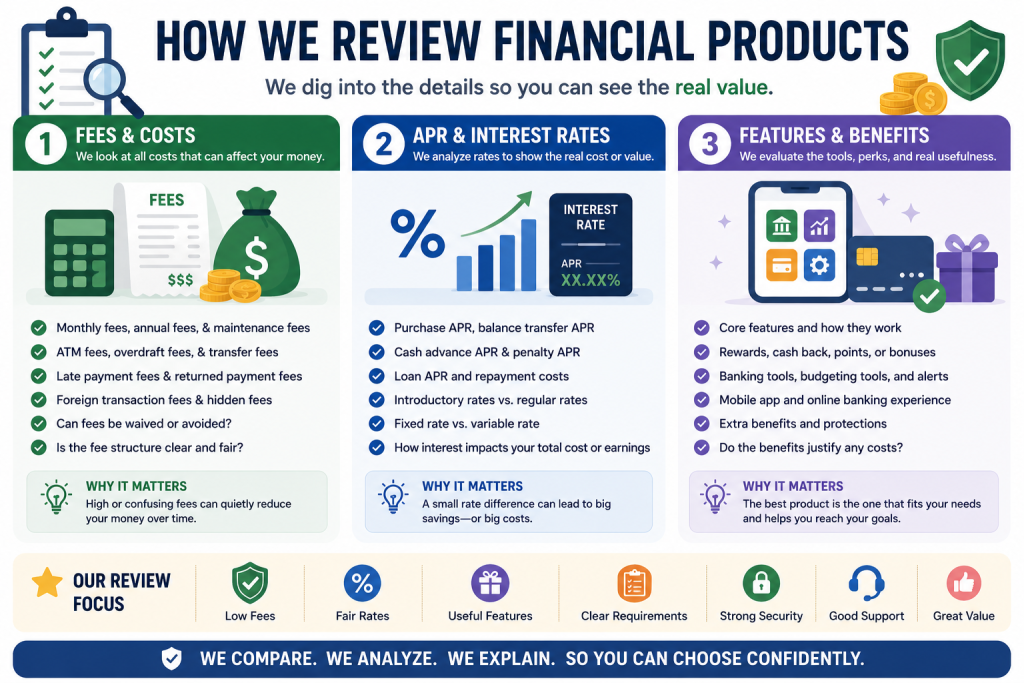
Fees are one of the most important parts of any financial product review.
A financial product may look attractive, but fees can reduce its value.
For bank accounts, common fees may include monthly maintenance fees, overdraft fees, ATM fees, wire transfer fees, paper statement fees, and account closing fees.
For credit cards, common fees may include annual fees, late payment fees, balance transfer fees, cash advance fees, and foreign transaction fees.
For loans, common fees may include origination fees, late fees, prepayment penalties, application fees, and service fees.
For finance apps, common fees may include monthly subscriptions, premium plan fees, instant transfer fees, and upgrade costs.
When reviewing fees, we consider:
- What fees exist
- When fees apply
- Whether fees can be avoided
- Whether the product has lower-cost alternatives
- Whether the benefits justify the cost
- Whether the fee structure is easy to understand
For beginners, simple products with clear and low fees are often easier to manage.
We Review APR and Interest Rates
APR and interest rates are important when reviewing credit cards, loans, and savings products.
APR stands for Annual Percentage Rate.
For credit cards and loans, APR helps show the cost of borrowing money.
A higher APR can make carried balances or loan repayment more expensive.
For savings accounts, interest rates work differently. A higher savings rate may help your savings grow more over time.
When reviewing APR and interest rates, we consider:
- Purchase APR
- Balance transfer APR
- Cash advance APR
- Penalty APR
- Loan APR
- Savings interest rate
- Introductory rates
- Regular rates after promotions end
- Whether the rate is fixed or variable
- How interest affects the total cost
Beginners should not choose a product only because of a low monthly payment, rewards offer, or headline rate.
The full cost matters.
We Check Features and Benefits
Features and benefits can make a financial product more useful.
However, not every feature is valuable for every person.
A bank account may offer mobile check deposit, online bill pay, ATM access, account alerts, direct deposit, debit card controls, or savings tools.
A credit card may offer cash back, points, travel benefits, purchase protection, fraud alerts, or credit score tools.
A loan may offer fixed payments, flexible terms, no prepayment penalty, fast funding, or online account management.
A finance app may offer spending tracking, budgeting tools, subscription monitoring, savings goals, reminders, and account alerts.
When reviewing features, we ask:
- Are the features useful?
- Are they easy to understand?
- Are they available for free or only with a paid plan?
- Do they fit beginner needs?
- Do they encourage better money habits?
- Are there limits or conditions?
- Are the benefits worth any fees?
A product with many features is not always better.
A simple product that works well may be more useful than a complicated product with tools you never use.
We Consider Requirements
Many financial products have requirements.
These requirements can affect whether a product is realistic for a beginner.
Bank accounts may require a minimum opening deposit, minimum balance, direct deposit, or certain monthly activity.
Credit cards may require credit history, income information, identity verification, or approval standards.
Loans may require credit checks, income verification, employment information, debt review, collateral, or other documents.
Finance apps may require account linking, identity verification, paid subscriptions, or personal data access.
When reviewing requirements, we consider:
- Minimum deposit requirements
- Minimum balance rules
- Direct deposit requirements
- Credit score expectations
- Income requirements
- Identity verification
- Account linking requirements
- Membership requirements
- Application process
- Whether requirements are clear
A product may not be a good fit if the requirements are difficult to meet or unclear.
We Review Security and Privacy
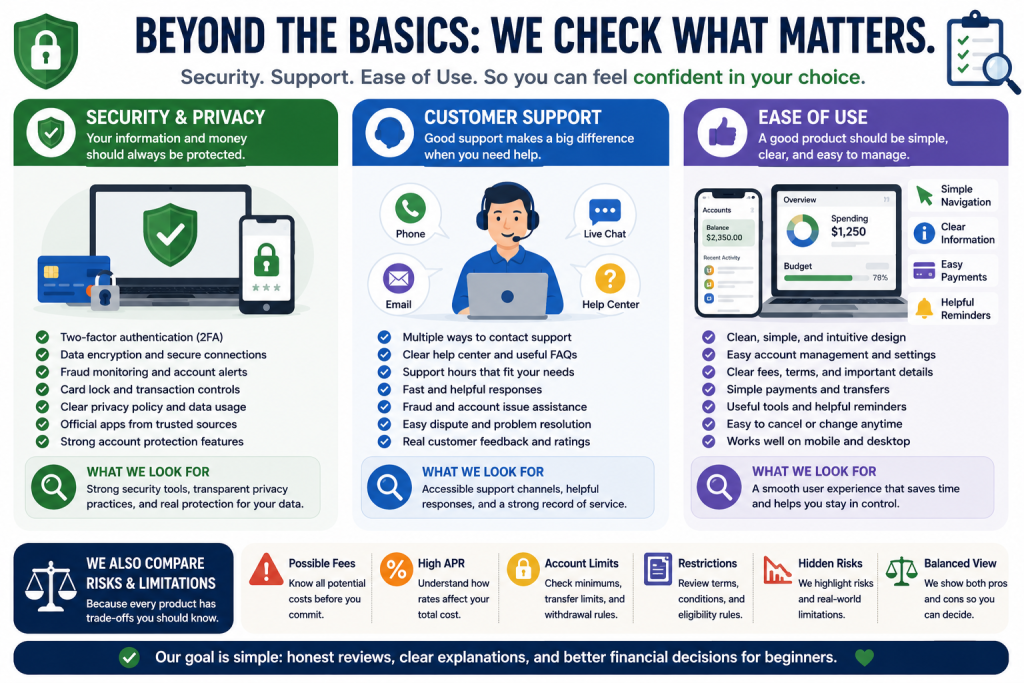
Security and privacy are very important, especially for online banking, finance apps, credit cards, and digital financial tools.
A financial product may involve sensitive personal and financial information.
This may include your name, phone number, address, bank account details, transaction history, income information, card data, or identity documents.
When reviewing security and privacy, we look for:
- Two-factor authentication
- Secure login
- Account alerts
- Fraud monitoring
- Card lock tools
- Data encryption
- Privacy policy
- Data-sharing rules
- Account protection features
- Official app availability
- Clear security explanations
For finance apps, privacy is especially important because some apps may collect spending behavior, account data, or personal information.
Beginners should be careful with products that are unclear about how data is used or protected.
We Look at Customer Support
Customer support matters because financial products can involve urgent questions or problems.
You may need help with login issues, payment problems, card replacement, suspicious transactions, account closure, loan payoff, app cancellation, billing questions, or account access.
When reviewing customer support, we consider:
- Phone support
- Live chat
- Email support
- Secure messaging
- Help center articles
- Support hours
- Response time
- Fraud support
- Complaint patterns
- Ease of contacting support
A financial product may look good, but poor customer support can become a problem when something goes wrong.
For beginners, clear and accessible support can be very helpful.
We Consider Ease of Use
A financial product should be easy to understand and manage.
If a product is too confusing, beginners may make mistakes or stop using it.
For bank accounts, ease of use may include simple online banking, clear statements, useful alerts, and an easy mobile app.
For credit cards, ease of use may include clear payment information, simple rewards, easy account access, and due date reminders.
For loans, ease of use may include clear repayment schedules, simple payment options, and transparent payoff information.
For finance apps, ease of use may include simple navigation, clear categories, helpful reminders, and easy cancellation options.
When reviewing ease of use, we ask:
- Is the product simple to understand?
- Are the main features easy to find?
- Are fees and terms easy to locate?
- Is the app or website clear?
- Are statements and payments easy to review?
- Can beginners use it without confusion?
- Are cancellation or account changes easy?
Simple and clear products are often better for beginners.
We Compare Risks and Limitations
Every financial product may have risks or limitations.
A bank account may have overdraft fees, ATM limitations, minimum balance rules, or transfer limits.
A credit card may have high APR, annual fees, penalty fees, spending temptation, or complicated rewards.
A loan may have interest costs, monthly payment pressure, origination fees, late payment consequences, or repayment limits.
A finance app may have subscription costs, privacy concerns, account linking requirements, limited free features, or cancellation issues.
When reviewing risks, we consider:
- Possible fees
- High APR or interest costs
- Missed payment consequences
- Account restrictions
- Transfer or withdrawal limits
- Data-sharing concerns
- Cancellation difficulties
- Eligibility rules
- Benefit limitations
- Fine print conditions
A good review should explain both benefits and risks.
Beginners should avoid products that look useful but have costs or limitations they do not understand.
Why Beginners Should Read Reviews Carefully
Beginners should read reviews carefully because financial products are not one-size-fits-all.
A product that works well for one person may not work well for another.
For example, a rewards credit card may be useful for someone who pays the full balance every month, but risky for someone who may carry a balance.
An online bank may be useful for someone who prefers digital banking, but not ideal for someone who needs branch access.
A finance app may be helpful for tracking spending, but not worth paying for if the free features are enough.
A loan may help in certain situations, but it can also create long-term repayment pressure.
Reviews can help beginners understand the trade-offs before applying.
How to Use Reviews the Right Way
A review should be used as a starting point, not the final answer.
Before applying for a financial product, compare the review with the official terms from the provider.
Check the current fees, APR, requirements, features, and policies directly from the company.
Also think about your own habits.
Ask yourself:
- Do I really need this product?
- Does it solve a real problem?
- Can I afford any fees?
- Can I manage the payments?
- Do I understand the terms?
- Does it fit my financial goals?
- Are there better alternatives?
The right product should fit your real needs, not just look attractive in a review.
Common Review Factors Beginners Should Check
Before using any financial product review, beginners should look for these key points:
- Fees
- APR or interest rate
- Requirements
- Main features
- Security
- Privacy
- Customer support
- Ease of use
- Limitations
- Cancellation rules
- Who the product is best for
- Who should avoid it
A review that only talks about benefits may not be complete.
Balanced reviews should also explain costs, risks, and limitations.
Common Beginner Mistakes
One common mistake is choosing a product only because it has good reviews.
A product can have good reviews and still not fit your situation.
Another mistake is focusing only on rewards, bonuses, or popular features.
Some beginners ignore fees or APR.
Others do not read the official terms before applying.
Another mistake is assuming that all finance apps, credit cards, bank accounts, or loans work the same way.
They can be very different.
Some people also forget to check cancellation rules, privacy policies, or customer support.
Reviews are helpful, but your own review of the terms is still important.
Final Thoughts
Financial product reviews can help beginners compare options more clearly.
When reviewing financial products, important factors include fees, APR, interest rates, features, requirements, security, privacy, customer support, ease of use, risks, and limitations.
A good financial product should be clear, useful, affordable, secure, and suitable for your needs.
Before applying for a bank account, credit card, loan, finance app, or other financial product, read reviews carefully and always check the official terms from the provider.
For beginners, the best product is usually the one that is easy to understand, easy to manage, and realistic for your financial life.
Disclaimer
The information in this article is for educational purposes only and should not be considered financial, legal, tax, credit, banking, loan, investment, cybersecurity, or privacy advice. Financial product features, fees, APRs, interest rates, requirements, security tools, privacy policies, customer support options, and provider terms may change over time. Always review the official terms and disclosures from the financial institution, lender, card issuer, app provider, or service provider before applying for or using any financial product. If you have questions about your personal financial situation, consider speaking with a qualified professional.
Leave a Reply